
THEORETICAL OBSERVATORY
Temporal Experiments, Stratifications of Matter in the Spacetime Flux (Text from 1994 concerning works conceived in 1985©)
The artistic practice known as “temporal experiments,” initiated in 1985, radically overturns the traditional concept of the artwork as a closed and immutable entity. Whereas the classical conception holds that a work is created at a specific moment and remains forever identical to itself, this research introduces time as a constitutive element and co author of the creative process. A work is given a title, a date, and a time of completion, but this “completion” is only apparent. After one year, three, five, ten, or fifteen years, the artist may return to it, add new elements, and record once again the exact moment of the intervention. Each temporal stratification thus becomes a visible trace of the passage of time, transforming the work into an organism that grows through the years, accumulating chronological intervals and distances. What emerges from this practice finds a striking correspondence with contemporary physics, not by derivation but through independent convergence. When a mark is added to a work after five years, a superimposition is created of different temporal moments coexisting within the same physical space. The work becomes a place where different times touch, layer upon layer, and enter into dialogue. A fragment from 1986 may enter into direct relation with a fragment from 1989, and both in turn with a fragment from 2001, creating a temporal weave that challenges ordinary chronological linearity.
This artistic intuition resonates with the Einsteinian revolution of relativity, which demonstrated that space and time are not separate dimensions but constitute a four dimensional continuum. Temporal experiments materialize this interconnection through artistic practice, making perceptible what physics has formulated mathematically, time is not a neutral container but an active dimension intertwined with space and matter. The research is not limited to painting or drawing on a traditional support. Some installations use sunlight to inscribe temporal displacement. Photosensitive materials change color, density, and form according to exposure to solar rays, allowing the work to alter itself autonomously without the artist’s direct intervention. The intensity and angle of sunlight continuously change due to the Earth’s rotation and its revolution around the Sun. An installation that records these variations is documenting cosmic movements, translating into visible form astronomical dynamics on a planetary scale. The result is a work bearing the imprint of the Earth’s movement through space, where time is made visible in its transformative action upon matter. The same principle governs the photographic documentation of a colony of mold spreading across a wall surface. The mold grows, transforms, and alters its morphology according to biological laws beyond human control. Documenting it at different moments means recording an autonomous process of transformation in which the work coincides with the very act of making visible the time that acts upon organic matter. This is not representation in the classical sense, the artist does not paint mold, but recognizes in mold itself a natural process worthy of artistic status. A similar approach characterizes the photographic documentation of a plant during its biological process, flowering, and senescence. The artist does not create the plant organism, but chooses to render it visible as a temporal phenomenon, to confer artistic meaning on a process that normally escapes attention because it is too slow for immediate perception. This implies a radical shift, art no longer necessarily consists in the manual production of forms, but may consist in the ability to recognize, select, and confer visibility upon processes that occur independently of human intention. Creativity is recognized also in natural phenomena, in chemical and physical processes, in biological dynamics. The artist becomes an observer and cataloguer of processes rather than a creator of objects, adopting an approach reminiscent of the scientific method, isolate, observe, document with rigor. The precision with which the date and time of each intervention are recorded is not a formal quirk but an essential conceptual element. This precision establishes exact spacetime coordinates for each layer of the work. Each annotation fixes a precise point where an event, the artistic intervention, has taken place. The sum of these annotations creates a temporal map of the work, a stratified chronology that makes it possible to reconstruct not only when but also at what temporal distance the interventions occurred. A work with annotations five years apart tells a different story from one with interventions six months apart, the waiting time, the maturation time between one intervention and the next, becomes an integral part of the meaning. It is a matter of recognizing and valuing the long durations of material, biological, and existential processes, durations that cannot be accelerated without altering the phenomenon itself. A plant cannot grow in a second, mold does not spread in an hour, wood does not deform in a day.
The difference from traditional art is clear, whereas an ancient or contemporary artwork aspires to eternity, seeking to freeze a moment and render it immutable, temporal experiments embrace change as a constitutive element. They do not fight deterioration but document it, they do not fear transformation but incorporate it. One moves from an aesthetics of result to an aesthetics of process, from an art of the finished object to an art of continuous becoming. Traditional art seeks to minimize entropy, disorder, and degradation, whereas temporal experiments recognize entropy as an inevitable and productive part of material reality. The practical implications are considerable. If a museum institution were to acquire a temporal experiment, what exactly would it be acquiring, a physical object destined to change, the artist’s right to intervene in the work even after transfer of ownership, the complete documentation of all prior states of the work. Questions arise not only on an aesthetic level but also on legal, economic, and conservation grounds. How does one restore a work conceived to change, how does one preserve that whose meaning lies precisely in not being preserved in its original form. Traditional museology and conservation, founded on the idea of maintaining works as close as possible to the moment of their creation, are thrown into crisis by practices that make transformation their founding principle. This artistic practice belongs to a cultural horizon in which the very notion of the artwork as a closed entity has been called into question. Yet temporal experiments present a specificity, these are not simply works that change or deteriorate, as inevitably happens by virtue of the second law of thermodynamics, but works designed from the outset to be taken up again years later, where each reprise constitutes a fully intentional creative act precisely dated. Temporal stratification is not a by product of natural decay but the very content of the work, willed and programmed by the artist.
[Note 2025] The logical consequence of this practice is the concept of “spacetime unrepeatability,” every intervention on a work occurs in unique and non replicable spacetime coordinates, rendering each moment of the work ontologically unrepeatable. The identity of the work no longer resides in a fixed form but in the temporal process that traverses it, in that continuity linking interventions separated by years or decades. Temporal experiments offer a mode of experiencing time that does not pass through abstract conceptualization but through the sensory perception of transformations, of chronological distances made visible in matter. In this sense, they constitute not only an artistic practice but also a cognitive instrument for investigating the physical nature of time and change through direct experience of matter in transformation.
V R
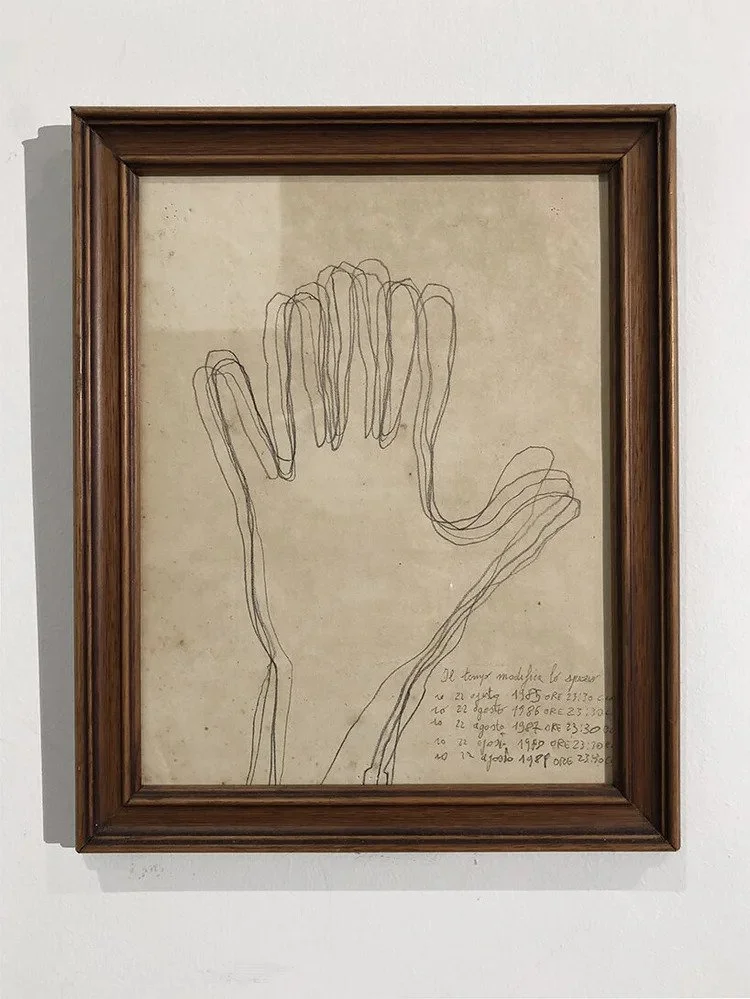
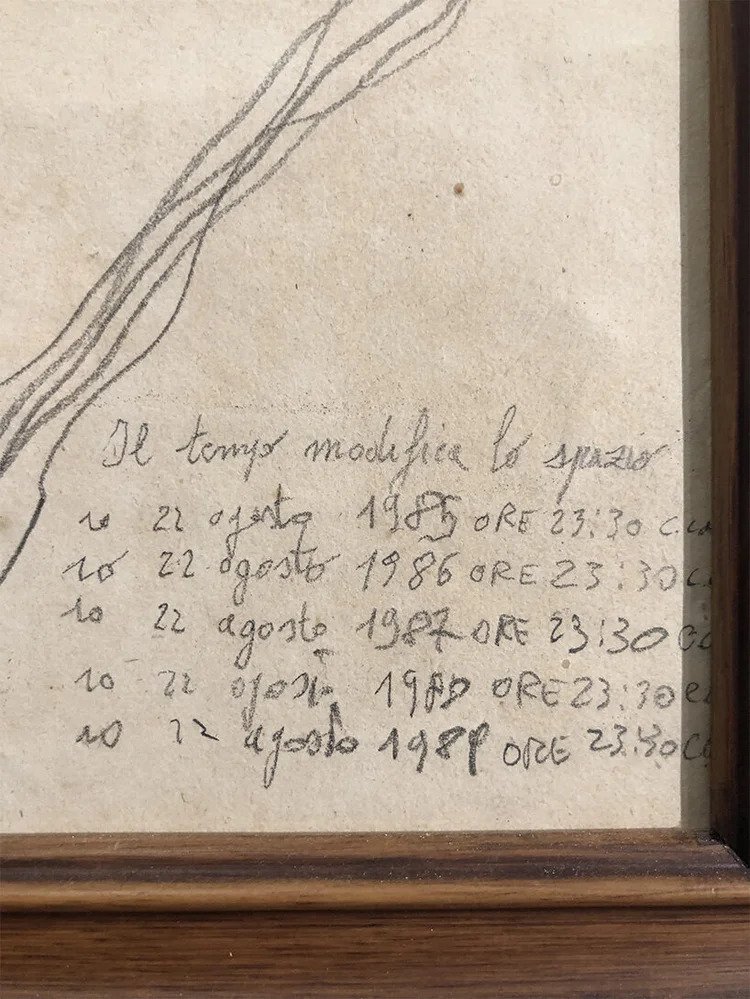
Time changes space (Time experiments) from 1985 to 1989©. Cm 33x23, graphite on paper. Work carried out every year for 4 consecutive years. The trial ended on August 22, 1989 at 11:30 pm.
Privacy Policy Image Licensing
All rights reserved Virgilio Rospigliosi 2023© Design by Lux Aeterna Multimedia